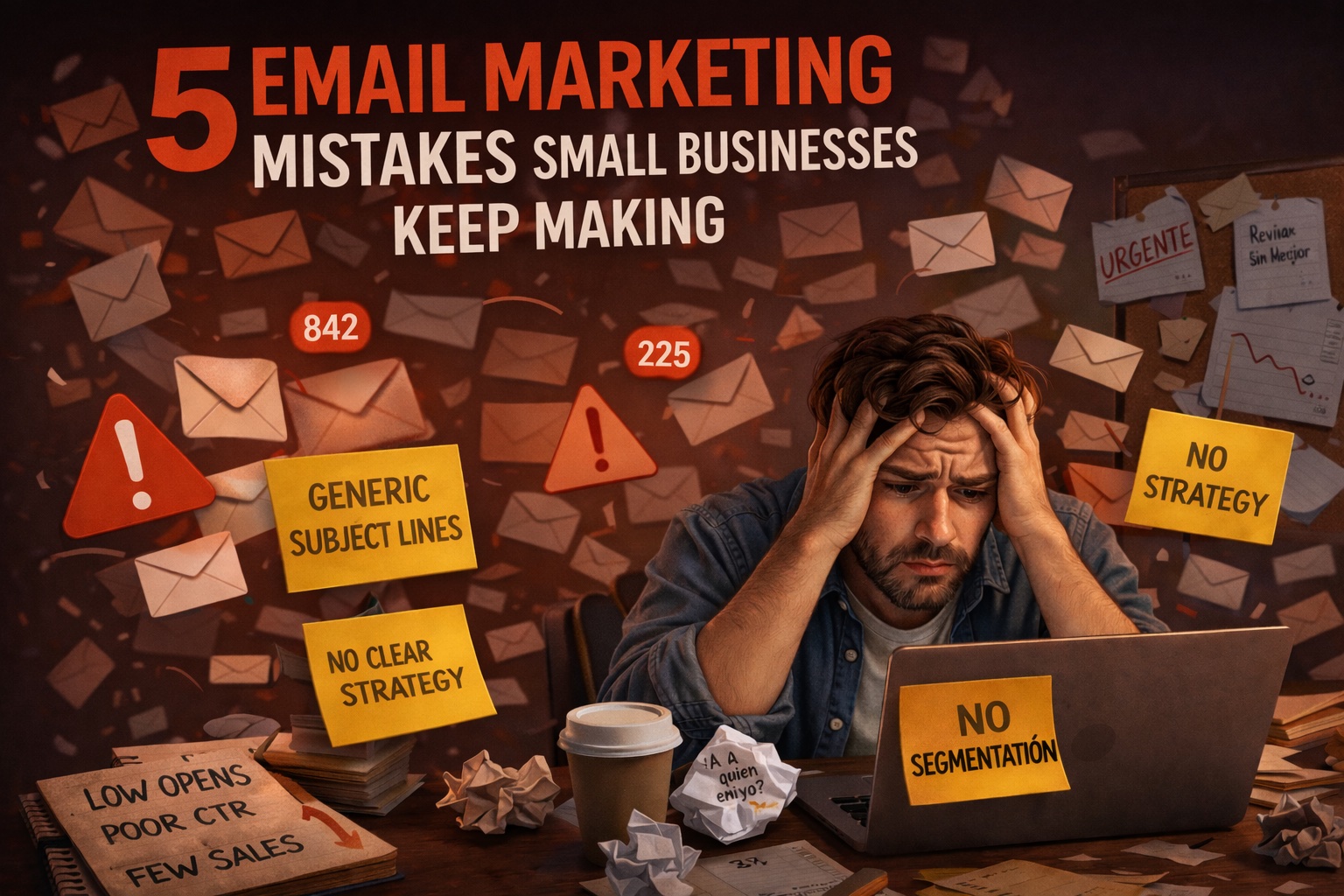
Doing email marketing "without a team" is the reality for most small and medium-sized businesses. The business owner, or someone on the team juggling a hundred things at once, sits down one day to send a newsletter. No specialized training, no time to research, no clear process.
The result: campaigns nobody opens, shrinking lists, and the nagging feeling that "email marketing just doesn't work for us." But the problem is almost never the channel — it's the execution.
Here are the five most common mistakes, and why fixing them changes everything.
Sending without a strategy: the "when I remember" email
Reactive email marketing — sending only when there's a promotion or when someone says "shouldn't we send something?" — is one of the most costly mistakes. Without an editorial calendar, clear campaign objectives, or a consistent send frequency, your subscribers don't know what to expect from you. And what isn't expected gets ignored.
A strategy doesn't have to be complex. It's enough to define how often you send, what goal each type of email serves (nurture, sell, retain), and how they connect with each other. Without that foundation, every send is a shot in the dark.
Treating your entire list like one person
Sending the same message to your entire contact base — from recent customers to people who subscribed two years ago and haven't opened anything since — is a recipe for low open rates and high unsubscribe numbers. Segmentation isn't a luxury reserved for big companies; it's the difference between a relevant email and one that goes straight to the trash.
With basic segments — active vs. inactive customers, declared interests, purchase behavior — you can multiply the effectiveness of your campaigns without creating completely different content for every group.
"The most effective email isn't the best-written one — it's the one that reaches the right person at the right moment."
Ignoring metrics until something goes wrong
Many SMBs send campaigns and don't look at the results until unsubscribe rates suddenly spike or their email provider warns them about reputation issues. Metrics aren't just numbers in a dashboard — they're the most honest feedback you have on whether your communication is working or not.
The key metrics to review after every send:
- Open rate: Does your subject line hook people? Do they recognize your sender name?
- Click-through rate (CTR): Does the content generate enough interest to drive action?
- Unsubscribe rate: If it rises, something in your frequency or relevance is off.
- Bounce rate: An uncleaned list damages your sender reputation.
- Conversions: Ultimately, is email contributing to the business?
Writing generic emails that look like spam
An email that could have been sent by any company in your industry isn't going to stand out. Without personalization, without a distinct voice, without context that's relevant to the recipient — that email competes directly with dozens of others in the inbox, and loses. The most common mistake is confusing "mass communication" with "impersonal communication."
Personalization goes beyond putting a name in the greeting. It's about sending the right content based on where each person is in their relationship with your business: someone who just bought needs a different email than someone who hasn't engaged in months.
Not automating anything because "there's no time to set it up"
The irony of manual email marketing is that it consumes the very time you don't have. Setting up a basic automation — welcome to new subscribers, post-purchase sequence, reactivation of inactive contacts — requires an upfront time investment, but then it works on its own. Without automations, every campaign depends on someone remembering to send it, and that doesn't scale.
The most impactful automations for a small business without a team are precisely the simplest ones: a well-written welcome email can achieve open rates three times higher than a regular newsletter. And you only set it up once.
What do all five mistakes have in common?
They all point to the same underlying problem: doing email marketing without a team means nobody has the time to do well what requires sustained attention. Strategy, segmentation, metrics analysis, personalization, and automations aren't five-minute tasks — they're a specialist's full-time job.
And there's the real dilemma for SMBs: hiring that specialist is expensive, and going without one means continuing to make these mistakes.
The solution isn't to hire a team — it's to have one without hiring
That's exactly what MailyGent does. It's an AI agent that acts as the marketing team your business can't afford to hire: it defines the strategy, segments your audience, generates the content, analyzes results, and optimizes every campaign continuously.
It doesn't replace your email service provider (it works with whatever you already use), and it requires no technical knowledge. It simply does for you everything that these five mistakes show is hard to do alone.
If you recognize any of these mistakes in how you're currently running email marketing, try MailyGent for free and see what a difference real strategy makes behind every send.